• JOURNAL
  • ARCHIVE
  • ABOUT
  • SUBSCRIBE
  • CONTACT
Menu

Wenglinsky Review

Culture, Social Structure & Politics from a Sociology Professor
  • JOURNAL
  • ARCHIVE
  • ABOUT
  • SUBSCRIBE
  • CONTACT

Ellsworth Kelly, Blue White, 1962. Oil on canvas. Rose Art Museum.

Thought-Provoking Essays Include: Continuous Disabilities, Fascist Science Fiction, The Politics of Drag Queens, Thomas Cole’s The Voyage of Life,  The Fundamentals of Social Roles,  Radical Sociology,   Women Are An Attractive Nuisance,   The Three Kinds of Being: The Nature of Stories, The High Victorian and the Late Victorian,  Tara Westover's Educated,   The Stratification of Disability,  The Philosophy of Education,   Jane Austen's Conservatism,  Sargent and Beauty, Chomsky’s Imperialism, Grand Themes in Literature

A Short Post On: The Iran War is a personal and political  diversion, The Epstein story is not a conspiracy, Ukraine, Race, DEI, Impeachment, Taxes, Gaza, Shutdown, One Month In

Rerelease, a Fresh Take on Timeless Columns: Why Noam Chomsky Is Wrong, Comedy and Tragedy in Pride and Prejudice, Shakespeare's Greatest Melodramas, The Fundamentals of Social Roles,  Kahneman's Fallacies, Thinking, Fast and Slow

Archives: Art Criticism,  Jane Austen,  Shakespeare,  Philosophy,  Literature,  Social Structure,  Religion,  Politics, Everyday Life,  Roles,  Film,  War,  Education,  Favorites, and  Primers.

No results found

To receive a brief e mail about new posts, go here.

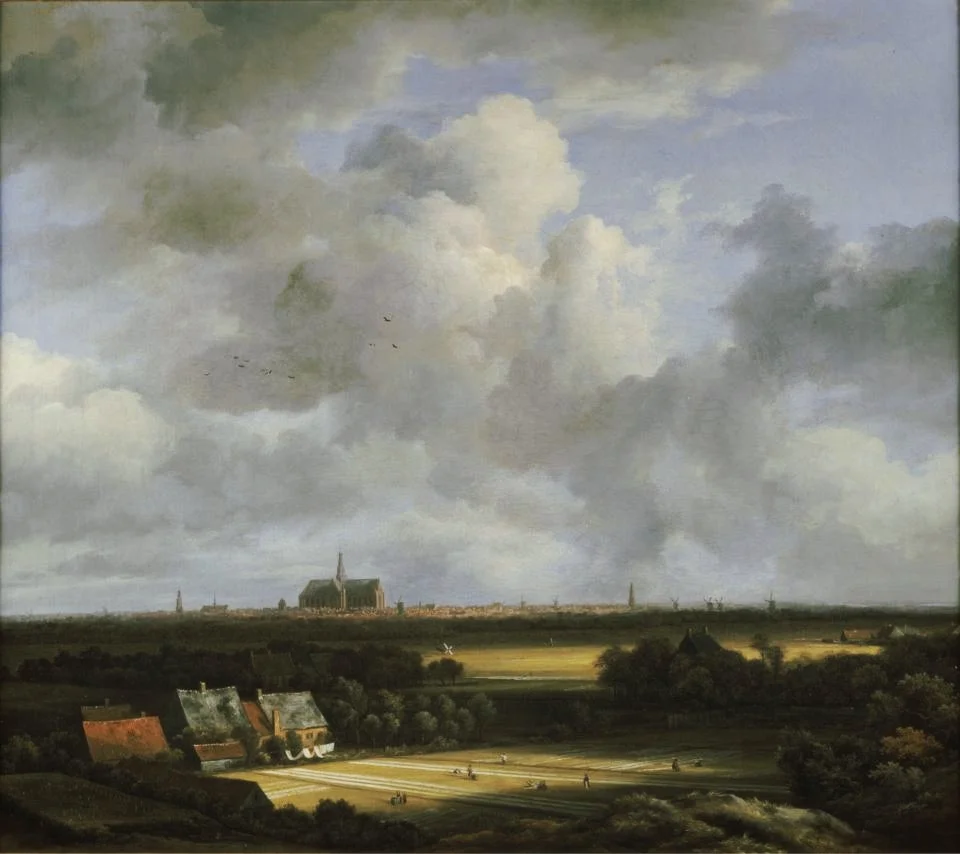
View of Haarlem with Bleaching Fields (c. 1670–1675), Jacob van Ruisdael, courtesy of The Frick Collection.

View of Haarlem with Bleaching Fields (c. 1670–1675), Jacob van Ruisdael, courtesy of The Frick Collection.

Landscapes and Townscapes

January 21, 2018

Jacob van Ruisdael was a master of both landscapes and what we would now consider townscapes because they were paintings of what were then the urban vistas. Looking at his paintings allows seeing how he did these two kinds of paintings differently. That can supply the basis for generalizations about the nature of landscapes and cityscapes and, even beyond that, the nature of the human experiences that underlie aesthetic experience.


“View of Haarlem with Bleaching Grounds” is characteristic of van Ruisdael’s depiction of a town, which appears as a sliver in the middle of the painting, most of which is taken up by the grayish sky above or, beneath the sliver, a suburban part of town that contains a bleaching ground, where long strips of cloth are laid out to dry. The town itself is notable for a few church spires, one overlarge building, some windmills, and its rust color, while the bleaching ground is set amidst some trees and a few buildings, and its linearity can be taken to be an horizontal echo of the vertical linearity of the town. People, as everyone knows, make their marks on places by constructing with the use of straight lines. The other point to be made is that the downtown of Haarlem goes on for a while, stretching from the left to the right of the canvas, and gives a suggestion that it also bulges out, so that a bird’s eye view (there are birds in the picture) would see a great circle filled with houses, both residences and public buildings. The only people to be seen are, ironically enough, not in the town, but working the bleaching ground, and they are fairly small because the point of view van Ruisdael takes is remote from the scene, more concerned with the overall geography of the place than the life within it, many buildings to be found widely spaced from one another, in the plain between the bleaching ground and the town proper.  


“Panoramic View of the Amstel Looking towards Amsterdam” is a townscape which is less parsimonious in that it gets close enough to its subject so as to portray much more of the way the city works. There is the Amstel River, filled with white sailed boats, broad in the south east corner of the picture, and then narrowing towards the bridge at the center of the picture, its horizontal line serving as the center point of the picture, the buildings of the city behind it, the far shore filled with buildings of various sizes, while the near shore has windmills, houses, and a promenade where the people who saunter up and down provide a sense of scale. The town is bustling with activity: men oaring a raft, fields with mounds of hay, and the activities that might be suggested to go on in windmills, residences and public buildings, though without the benefit of any particular story being unravelled, as was the case with the human interest sidebar provided in the portrait of Haarlem by the presence of the bleaching field, something remarkably noticeable then as it would be if one showed up today. A townscape is therefore a single place where people go about their business in close proximity to one another but where their stories do not intertwine. That remains the collective story of towns and cities.


Now consider how different is a landscape. In “Dunes”, perhaps his most famous painting, Ruisdael introduces an individual story into his portrait of a landscape. A man and his dog are trudging up a rutted path, one which can be traced back to where it disappears behind a hill. On either side of the path, interesting enough in itself because of its rise and falls, so that one would have a different perspective every few steps when wandering along it, are the brush that can be found on dunes, as well as some short trees. The plants go off in any number of directions, sometimes constituting a rough underbrush, sometimes a tiny copse of trees, sometimes the grass clinging to the tops of dunes, sometimes covering what is just a sandy stretch next to the road. There is no pattern in the flora to guide the eye, though an expert might know where and when different kinds of flora will grow on this kind of site. For the viewer to take hold of the scene, however, the man and his dog are very useful. The same is true of “Stag Hunt in a Wood with a Marsh”. The main pattern of the painting are the virticals of the trees, all of them leaning to the left, as if that is the way the wind blew them as they grew. They are planted both in the earth and in the marsh that takes up the center of the foreground of the picture. And yet Ruisdael relieves this landscape by putting huntsman into it as well as a stage being pursued by dogs who are catching up with it while it is in the marsh. Why this need to have a story going on rather than the landscape presented for itself alone. There needs to be a reason for the convention.


Not that all of Ruisdael’s landscapes have humans in the picture. Sometimes it is a waterfall that serves as a focal point, or an old ruined castle (the fact of which is proof of human engagement in the locale of the landscape). In “Waterfall in a Hilly Wooded Landscape”, the story line seems to be to be what I see as tree roots left over after, I presume, humans have harvested the lumber, though here again one would think that Ruisdael could have done without in that the broken tree in the foreground creates interest enough while the trees in the back stand tall and green.


Other Seventeenth Century painters follow the same convention of placing people in the landscapes, while not putting them in cityscapes. Meindert Hobbema, another Dutchman, includes people in his landscapes, “A Stream by a Wood” and in “The Avenue at Middelharnis”. The great Nicolas Poussin, a Frenchman painting in Italy at about the same time, has Orion, in “Blind Orion Searching for the Rising Sun”, stumble down a path very similar to the one found in “Dunes”, though this time people moving up the path have to scurry out of the way of the blind giant. This scene takes place in the midst of very lush scenery, the greenery of trees, leaves, bushes, grasses, painted with great care. That is very different from what Poussin does in the urban scene depicted in “The Rape of the Sabine Women”. Yes, it does contain people, but is an urban scene in that there are multiple individual stories going on in the midst of the chaos of the Roman men selecting and dragging off the Sabine women, the whole scene observed from afar by people on their balconies. City life may seem chaotic, but it is organized. The exception to the rule that contrasts townscapes and landscapes is Bruegel, another contemporary, who presents the boisterous and communal lives of villagers, each going about their own business and yet also involved in one another’s festivities, like a wedding. That liveliness of a village scene earns Brueghel the commendation that would be awarded by William Hazlitt, to William Hogarth a century and a half later: that he was one of the great comic writers.

Here is a suggestion as to why this convention makes sense. The portrayal of nature is always confusing because there is too little to focus the mind. Rather, a viewer of a landscape or someone out in actual nature is over stimulated by the ever new vistas of conflicting colors, different kinds of growth, none of which give off straight lines. There is nothing to steady the mind except, perhaps, a fallen tree or a rock filled brook that constitutes a mini-waterfall. There are too many objects-- trees, blades of grass, fallen brush-- to make it easy to concentrate the mind or to organize the picture. Cities, on the other hand, are dominated by their formal activities of milling, boating, manufacturing, it easy enough to identify a structure with a function, and so, indirectly, of human activity. For that matter, we consider landscapes to be domesticated when they show the signs of human organization, as in the hedgerows of Normandy, or Robert Frost’s New Hampshire stone walls, or even the stately planned trees of Hobbema’s “The Avenue at Middelharnis”. So painters know how the human mind organizes its perceptions, how it gives them order, so as not to make people overcome with the information they need to process, as would be the case if one were left alone, standing in a forest or looking at a landscape, not knowing where the eye is to settle, or where are the borders of the image, or how one green becomes a darker and then a lighter shade of itself, all of these shades following no particular order other than the rules of shading that apply when a place is sheltered from the sunlight. Nature is, in itself, overwhelming and so the portrayal of nature requires toning that down by the introduction of people or some clear dramatic interest, because people understand motives, which are either invisible or only indicated, far more easily than they understand nature all and to itself.

Read More
In PRIMERS, ART CRITICISM Tags Breughel, ; Hobbema; van Ruisdael
Comment

Latest Posts

Featured
FILM
Black and White Morals
FILM
Read more →
FILM
POLITICS, EVERYDAY LIFE
Ambiguities in Languague
POLITICS, EVERYDAY LIFE
Read more →
POLITICS, EVERYDAY LIFE
POLITICS, PRIMERS
A Short Primer in Socialism
POLITICS, PRIMERS
Read more →
POLITICS, PRIMERS
POLITICS
A Short Post on Trump
POLITICS
Read more →
POLITICS
LITERATURE
Generic Reading Practices
LITERATURE
Read more →
LITERATURE
JANE AUSTEN
Janeites
JANE AUSTEN
Read more →
JANE AUSTEN
LITERATURE, WAR
Propaganda in World War II
LITERATURE, WAR
Read more →
LITERATURE, WAR
POLITICS, SOCIAL STRUCTURE
The Assassination Attempt
POLITICS, SOCIAL STRUCTURE
Read more →
POLITICS, SOCIAL STRUCTURE
POLITICS, WAR
Spheres of Influence
POLITICS, WAR
Read more →
POLITICS, WAR
PHILOSOPHY, POLITICS
Metaphysics at the Supreme Court
PHILOSOPHY, POLITICS
Read more →
PHILOSOPHY, POLITICS
LITERATURE, RELIGION
Dante's Immorality
LITERATURE, RELIGION
Read more →
LITERATURE, RELIGION
POLITICS
Constitutionalism Two
POLITICS
Read more →
POLITICS
SOCIAL STRUCTURE
A Social Scorecard
SOCIAL STRUCTURE
Read more →
SOCIAL STRUCTURE
PHILOSOPHY, RELIGION
Genres of Social Theory
PHILOSOPHY, RELIGION
Read more →
PHILOSOPHY, RELIGION
POLITICS, WAR
Experiments in Regime Change
POLITICS, WAR
Read more →
POLITICS, WAR
POLITICS
A Short Post on Organizing
POLITICS
Read more →
POLITICS
POLITICS, WAR
A Third Short Post on Iran
POLITICS, WAR
Read more →
POLITICS, WAR
WAR, POLITICS
Another Short Post on Iran
WAR, POLITICS
Read more →
WAR, POLITICS
POLITICS, WAR
A Short Post on Iran
POLITICS, WAR
Read more →
POLITICS, WAR
RELIGION, LITERATURE
Creation Fables
RELIGION, LITERATURE

The stories earliest listed in “Genesis” are fables rather than myths and so disclose a higher level of consciousness than to be found with myths.

The creation story in “Genesis” is a far more modern thing than it is usually credited with being  It is a kind of philosophical presentation and so very different from mythology which, as Ovid, that great student of mythology, noted, there are always biological transformations of things even while the gods remain subject to the forces of nature and the raging of human passions. Narcissus may become his image only symbolically, and not all narcissists become their images, but these are still myths because of the element of biological transformation.. The stories that follow the creation story are best explained, on the other hand, as fables, which are stories that explain a set of circumstances that do not seem to be created but which somehow were at a point in time and have become part of nature. Tigers have stripes and the Red Man got baked right, neither too dark or too light.. Fables suggest that there is a history for what seems natural, a sometimes serious, sometimes fey attempt to make explicable what seems not to need explanation or else to make explicable something which seems paradoxical: how something could come into existence when it already had to be there. Good examples of fables that follow soon after the creation story are the tower of Babeel, which is an exaggeration of what people can build and what happens to them, which is to have multilingual peoples, or Noah’s ark, which is an exaggeration of a boat that could be built rather than transforming animals so they could swim.

Read more →
RELIGION, LITERATURE
FILM, LITERATURE
"The Night Manager"
FILM, LITERATURE

John Le Carre is a serious novelist.

The secret of spy novels and movies is that they describe ordinary people doing universal things, however exotic is the setting and the premises are and that the people act outside the law. People can’t escape from or suspend their human nature evgen if they think they are beyond the restraints of the law. A good or even exemplary item of that is available in Conrad’s “The Secret Agent” where an anarchist wanders around London with bombs wrapped around him under his coat feeling comforted that at any moment he could explode himself. That seems bizarre or crazy until the reader recognizes that this is a kind of freedom. The anarchist has freedom to destroy himself which is an ultimate freedom because his control over it is absolute and without the constraint of others, purely subject to personal will. All people want to some extent to do what they want, to say fuck you to the world however ugly it may be and that gets externalized in the image of that anarchist.

Read more →
FILM, LITERATURE
POLITICS
A Short Post on Epstein
POLITICS
Read more →
POLITICS
CoverStory-TOMINE_PostVacation.jpg.webp
ART CRITICISM
New Yorker Covers
ART CRITICISM
Read more →
ART CRITICISM
updike.jpg
RELIGION, LITERATURE
Updike's "Toward the End of Time"
RELIGION, LITERATURE

The first of a two part post on John Updike’s “Toward the End of Time” through the analysis of generic types.                                                                                                    

Persistently undervalued, except perhaps for his Rabbit novels, because he is regarded as covering up facile meaning with an engaging writing style, the quintessential New Yorker writer, John Updike deserves more appreciation, even in one of his lesser novels : Toward the End of Time”. But in order to appreciate the novel’s achievement, step back a few steps and consider the kind of book it is, which is what I call a deficient epic. Updike is very careful about what each of her novels are, whether the saga of “In the beauty of the lilies” or the polemical politics of “Terrorist” or “Couples” as the romantic serio-comedy.

Read more →
RELIGION, LITERATURE
RELIGION
Noah the Technologist
RELIGION
Read more →
RELIGION
POLITICS, SOCIAL STRUCTURE
The Battle of Minneapolis
POLITICS, SOCIAL STRUCTURE
Read more →
POLITICS, SOCIAL STRUCTURE
Audrey old and youn.jpg
ART CRITICISM, PHILOSOPHY
Celebrity Images of Old Age
ART CRITICISM, PHILOSOPHY
Read more →
ART CRITICISM, PHILOSOPHY
POLITICS, PHILOSOPHY
Three Kinds of Government
POLITICS, PHILOSOPHY

Why there are only three kinds of government--monarchy, legislative authority, and mob rule--is a good question.

There are only three kinds of government. All the other types are variations of the three however spectacular some of them may be. The three types can be found in Aristotle’s “Politics”. There are governments controlled by the upper classes, and those can be dictatorial. There are those run by the middle class, and those are sensible and responsible. There are those controlled by the lower classes and that results in mob rule. The modern formulation was identified in the seventeenth century by Spinoza who identified there to be monarchies, which rested in agriculture, governments led by legislatures, which are based on commerce, and charismatic governments led by mob rule.. Consider the basic types and their variations.

Read more →
POLITICS, PHILOSOPHY
RELIGION, LITERATURE
Adam and Eve
RELIGION, LITERATURE

The story of Adam andEve work as fables, while the storyu of Samson and Delilah work as romance.

The creation of a woman should not be seen as an afterthought by a God who had previously provided each of his animals with a mate but overlooked doing it for Adam. God may have thought that Adam was a special enough creation, meant to rule over the rest of it, and so he did not need a mate. But either God changed his mind about that or always knew that he would make a special creation later. Woman was a special creation so as to emphasize that in the actual world the relation between man and woman is not like it is with the pairings of the other animals; some special kind of creation was required. Eve was as close to Adam as his own rib. As a legend might, the story of Eve’s creation suggests that woman has thereafter an ambiguous relation to man: part of him, descended from him, and yet a companion to him, and so clearly something different from what happens with some other created species no matter how much it might occur to a son of Adam or a daughter of Eve that the two sexes had different natures. We can see this more clearly if we consider the type of literary undertaking the story of the Garden of Eden is.

Read more →
RELIGION, LITERATURE
RELIGION
Genealogy and "Genesis"
RELIGION

Longevity is a weighty matter in “Genesis” and beyond.

The geneologies listed in “Genesis” are usually treated as filler so as to show the passage of time, allowing the reader to get to the next juicy story. but the geneologies have literary weight in themselves even though most of the names listed in the “Genesis” genealogies do not have stories associated with them. These people are described only by their lineage and their longevity. The genealogies would seem to say that in those distant times men were indeed titans. How are they titans? “Genesis” says it is not a matter of size or of wisdom or of language or of power but a matter of age. Descent simply ties together people noteworthy for how long they lived.

Read more →
RELIGION

Stories & Analysis of the Intersection of Culture & Social Structure

© 2016 -2024 Martin Wenglinsky