

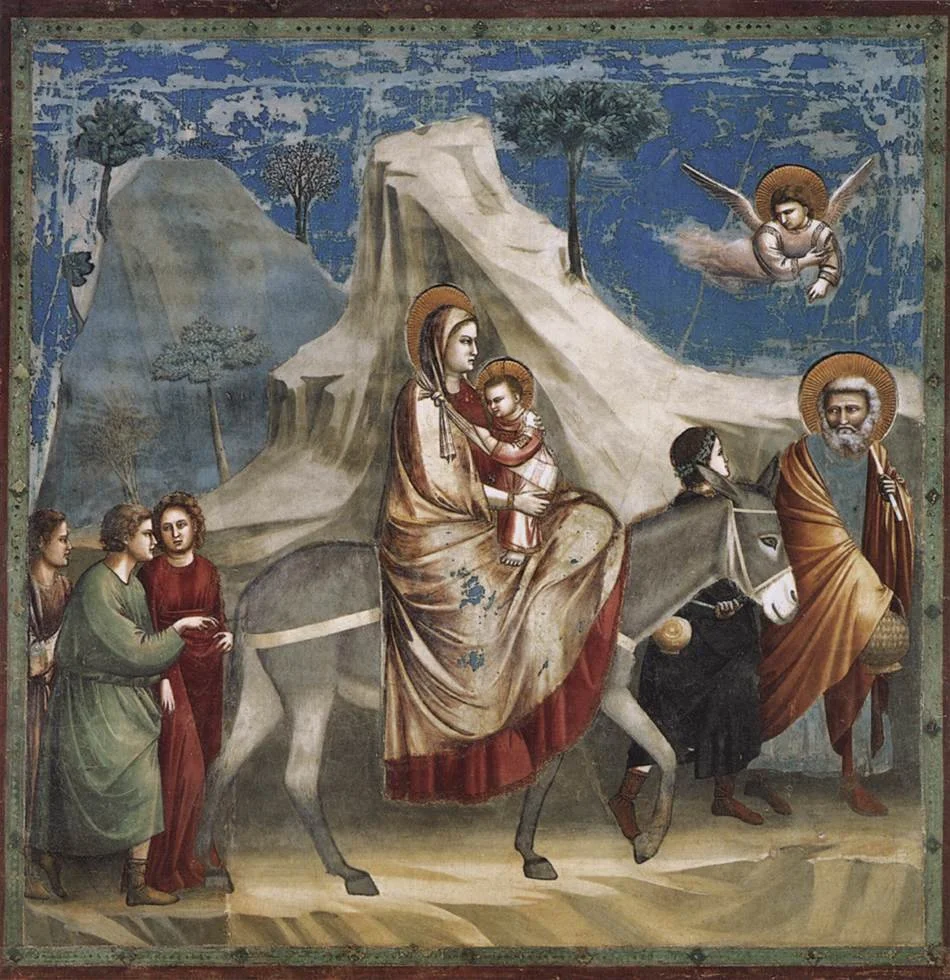
Ever since Grecian urns, with the exception of some medieval paintings devoted to sets of singular figures or numbers of figures juxtaposed to one another, and so very different from the assemblage of interacting figures in Rembrandt’s “The Syndics”, painting has provided stories that are unfolded by the juxtaposition of figures and settings with one another, as that is clearly revived by Giotto in his “The Escape to Egypt” where figures accompany Mary and Jesus on an ass, Joseph in the lead, and so offering a triumphal parade rather than a hurried escape, so as to make this a great event, revealing the significance of the journey as well as the kinds of people that accompanied it. Impressionism is a departure on its own in that it begins to focus on the spaces themselves between the figures, even though Dutch art in its landscapes had experienced space as well as Renaissance distances as part of the aesthetic experience.
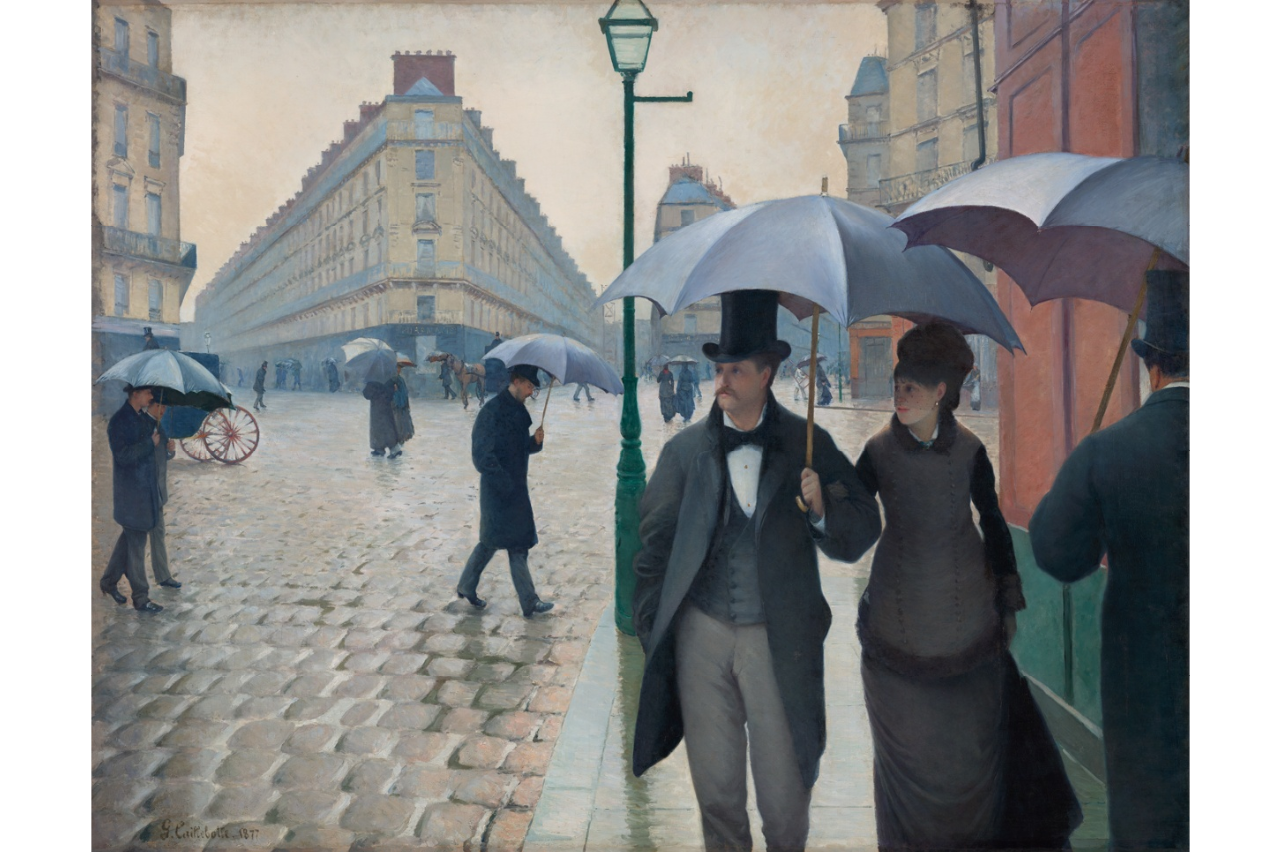
The most celebrated of the Impressionist Gustave Caillebotte’s paintings is “Paris Street; Rainy Day” because it does indeed capture a soaked urban street. It also coordinates its various figures and cityscape figures. To the right, on the edge of the frame, are figures with top hats and umbrellas, the other people in the street also with umbrellas, as if that were a custom rather than a convenience, this strange tribe of people always accompanied with this adornment, like Englishmen who carry an umbrella even if it is a sunny day. Umbrellas are like tophats, part of the fashion. The prominent figures are in the lower right and seemed cropped as in a photograph, while in previous centuries figures in Vermeer are just off center and Rembrandt figures are in the center of the field, as in “The Polish Horseman,” or else balanced around the center as in “Aristotle Consulting the Bust of Homer”.
The second element of that painting is the building in its upper center. It is not a spectacular piece of architecture but its placement as a street forking into two others makes an appealing streetscape of which there are so many in Paris, every turn offering a new configuration of streets, buildings and vistas. The third element of the painting is the street itself that stretches from beside the pedestrians and the building. The street is paved with stone bricks and Caillebotte manages to show them as wet, informed by what a rainy day looks like and the painting is unified in that all the features in the painting are rain spattered. But Caillebotte is also a bit adventurous in his presentation of a street receding into the distance. He does not violate the rules of perspective but he does not emphasize the diminishing distances between lines to a vanishing point as the way to see space, as that happens in Renaissance painting, or in showing far away places as through nearer by buildings or mountains. Rather, the flat or slightly inclined roadway is flat on, a space in itself, experienced as an area that takes up space, as real as the buildings and the people. People can walk on them, but they are a kind of monument, an object of space made by city planners, to be enjoyed for the view even if not seen as a monument, a streetscape not yet or just being recognized as an artwork, just as at that time Central Park and the Eiffel Tower are recognized not just as technological feats but as a kind of artistry without portraits or memorials to past wars and heroes. Quite an accomplishment.
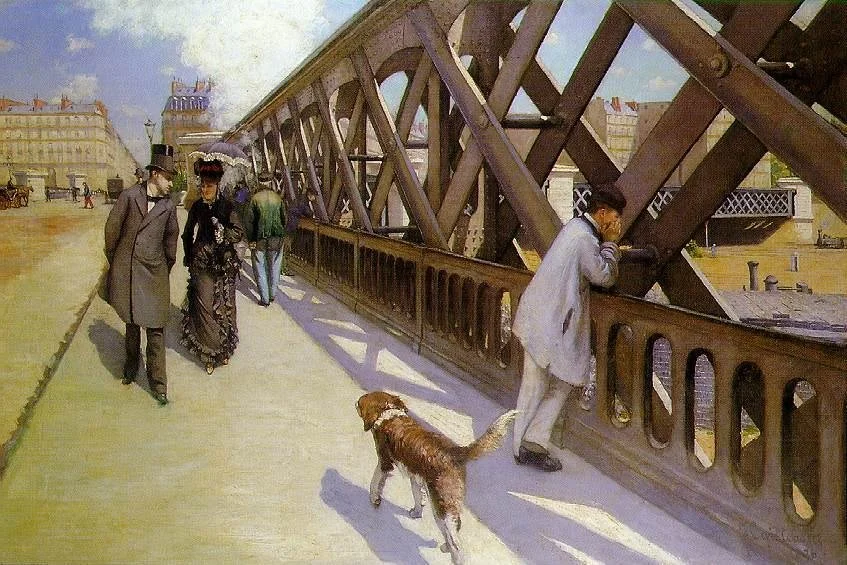
Caillebotte, Le Pont de l'Europe, 1876, Musee du Petit Palais
Another of Caillebotte's paintings that display an object that is not quite recognized as art is “Le Pont de L’Europe”, portraying a bridge across the Seine, where the apparent subject is a view of pedestrians who cross the bridge on a roadbed covered in sand and so might seem not very different from strolling across any lane in a village. The scene even shows a dog crossing the bridge and seems unaccompanied, just another of those sauntering through and so a bit of human interest in that Parisians are like present day New Yorkers in loving their dogs. Just a cute moment that brings a smile. But there is something else that is on the edge of the bridge and the painting. It is an iron railing that protects the river crossers and that may be part of the structure that holds it up, the Seine not so very wide that it needs overhead supports. This bridge is different from the graceful arches of a Roman aqueduct or the suspension bridges, like the Brooklyn Bridge, that at the time were coming into prominence. Rather, they are like the cast iron buildings created in major cities in the world at the time. There is an expanse of space horizontally across the bridge and the painting that is of interest and can be appreciated for its size, shape and texture if people care to consider it as an aesthetic object rather than a bit of necessary technology to be disregarded as art, just as an observer might today disregard building scaffolding as an eyesore if people do not decide it was to be decorated and artfully constructed, as might happen, just as people for a few decades regarded graffiti on walls as an eyesore that was transformed into art and then left behind as a dated style. The aesthetic point of the horizontal band is that it is uniform and smooth and so it is design without decoration, a new innovation, because it is different from human and dog shapes which are much more compact and so, in this case, go beyond the painting or are an extension without clear end that borders, constrains, or goes beyond these in being different, depending on how a pedestrian on the bridge or a viewer in a gallery will come to take it.

A feature of Impressionism that tried to escape from perspective was to separate near and far distances with borders or boundaries as is indicated in Monet’s “Garden at Sainte-Adresse” where the boundary between the near, which is on the garden behind the house is separated from the far which is the water where the boats can be observed from the garden. Caillebotte does the same thing by separating the near from the far by constructing barriers such as railings to demarcate the parts and so dispensing with perspective. In “Young Man at His Window”, a person looks out at angled buildings who are subject to perspective but what separates his own view and his room from the outside is a columned railing that is not angled, like the foreground view or the room behind him, but a perpendicular parallel to the space of the painting itself.
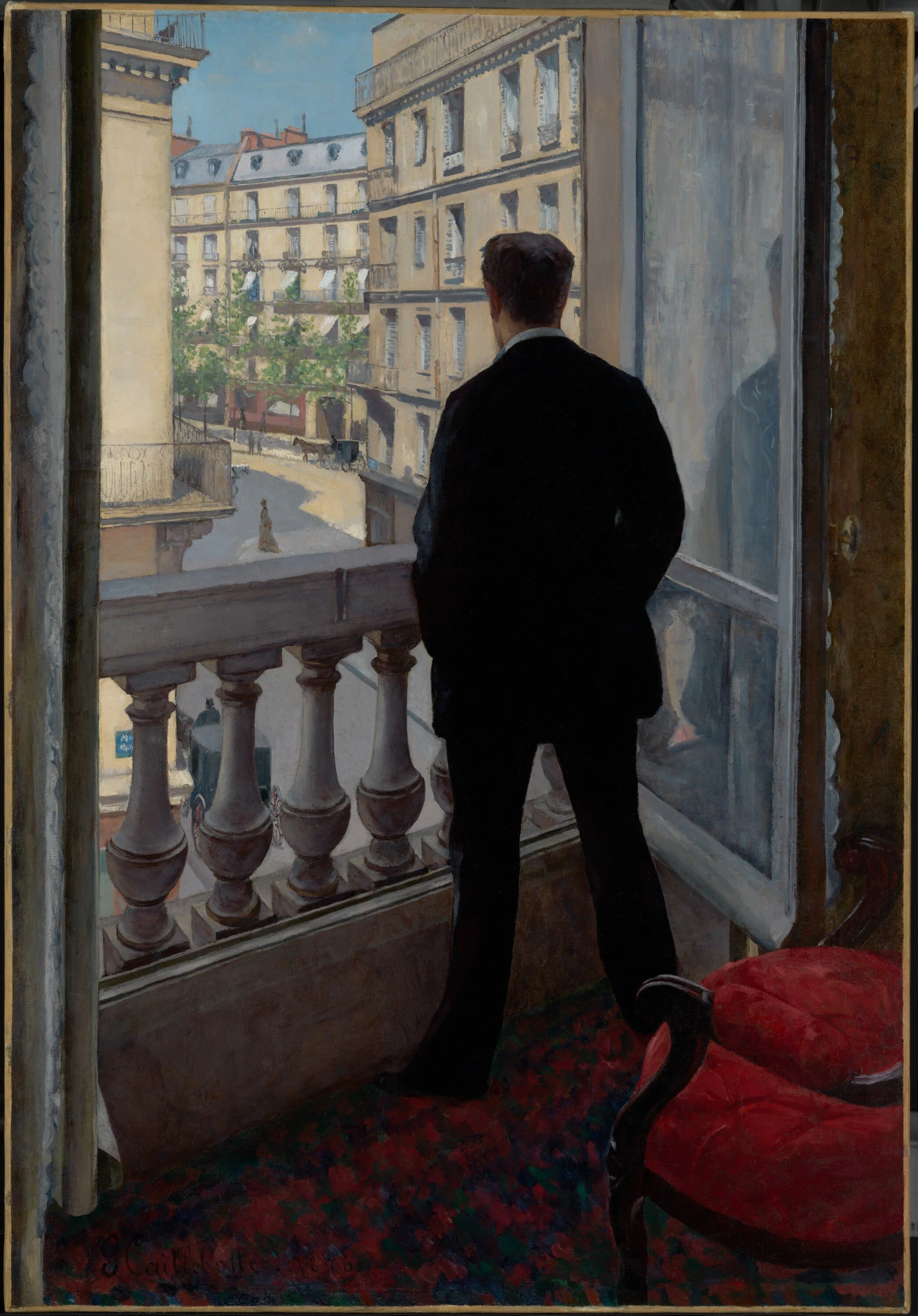
Caillebotte, Young Man at His Window, 1876, Getty Museum

Similarly, there is a latticed iron balcony that separates and so makes separate spaces in his “Man on a Balcony, Boulevard Haussmann” where perspective works on both sides but where the balcony is a perpendicular barrier, that the most important object in the painting because it instructs the painting by informing what separations are to be made and so the separation mark is a thing in itself, outside what has been depicted, though also depicted, because it exists as an instruction about space itself.
Impressionism was also known for using aspects of everyday life to engage with profound issues. Manet’s “A Girl in a Bar” shows a girl behind the counter being distracted but because of the angles it shows her as unobserved and so candid, not at all posed, her face without expression and so perhaps what she is really like, people now defined as real when they are not interacting with people. This is a very existential moment. CV. does the same thing when he takes as his subject matter people scraping down a floor in an apartment. Its obvious intent is to watch what would not seem to be worth portrayal: people engaged in a humdrum trade that arises so as to make apartment rooms ready for people to take up residence, a necessary supportive role for the presentation of the settings where life is staged and worth attending because we mostly do not attend to the way stagecraft are produced. But Caillebotte is onto a bigger game. He is displaying the space, the area, of that floor itself.
Look beyond the workmen to what it is they worked just as Michaelangelo asked us to see the statue inside the stone that is to be sculpted. What the workmen produce is akin to a flat plane akin to a triangle or a square or any other abstract object that is approximated bit not fully actualized. What is revealed is a facsimile of an area carved amidst its accouterments. The scrapings that still are present on the floor are now waste and to be dispersed so as to make the area as pure and in itself as much as possible, the workers also having left so that people can experience walking on tube varnished flooring so as to get a sense of the expanse that is under and around them, an expanse to be filled with furniture and rugs that do not alter the floor nonetheless as a floor, which is a man made thing that is now something inhuman inn that it is now geometric, expansive and so metaphysical, having nothing to do with people except for its accreditation. Caillebotte made something amazing and displayed it, as if an act of god.
Most of the large number of paintings created by Caillebotte are pleasant but not eye grabbing, but his half a dozen or so that depict spaces are remarkable and even more so for having jumped a period, from Impressionism into abstract Expressionism even while remaining representational. The great Modernist figures didn’t do that. Picasso was characterized by curves, whether in “Guernica” or “Woman in a Mirror” and putting multiple images and perspectives next to one another. Chagall’s paintings work hard at not providing centers but assemblies of objects. Abstract Expressionism, for its part, presented patches of color in Rothko that philosophers only imagined as what was preparatory in the mind to the intellectualization of an object with a color and Pollack portrayed depthless flatness when minds thought it an oxymoron and Kelly made space discontinuous, which also seems impossible until he made it so. But underrated Caillebotte sees spaces for themselves as objects of attention, the backgrounds the center of attention even if only sometimes the center of the painting. He still has to place the spaces within a real setting rather than leave them unadorned.