• JOURNAL
  • ARCHIVE
  • ABOUT
  • SUBSCRIBE
  • CONTACT
Menu

Wenglinsky Review

Culture, Social Structure & Politics from a Sociology Professor
  • JOURNAL
  • ARCHIVE
  • ABOUT
  • SUBSCRIBE
  • CONTACT

Ellsworth Kelly, Blue White, 1962. Oil on canvas. Rose Art Museum.

Thought-Provoking Essays Include: Continuous Disabilities, Fascist Science Fiction, The Politics of Drag Queens, Thomas Cole’s The Voyage of Life,  The Fundamentals of Social Roles,  Radical Sociology,   Women Are An Attractive Nuisance,   The Three Kinds of Being: The Nature of Stories, The High Victorian and the Late Victorian,  Tara Westover's Educated,   The Stratification of Disability,  The Philosophy of Education,   Jane Austen's Conservatism,  Sargent and Beauty, Chomsky’s Imperialism, Grand Themes in Literature

A Short Post On: The Iran War is a personal and political  diversion, The Epstein story is not a conspiracy, Ukraine, Race, DEI, Impeachment, Taxes, Gaza, Shutdown, One Month In

Rerelease, a Fresh Take on Timeless Columns: Why Noam Chomsky Is Wrong, Comedy and Tragedy in Pride and Prejudice, Shakespeare's Greatest Melodramas, The Fundamentals of Social Roles,  Kahneman's Fallacies, Thinking, Fast and Slow

Archives: Art Criticism,  Jane Austen,  Shakespeare,  Philosophy,  Literature,  Social Structure,  Religion,  Politics, Everyday Life,  Roles,  Film,  War,  Education,  Favorites, and  Primers.

No results found

To receive a brief e mail about new posts, go here.

mid_IWM_ART_001460_A.jpg

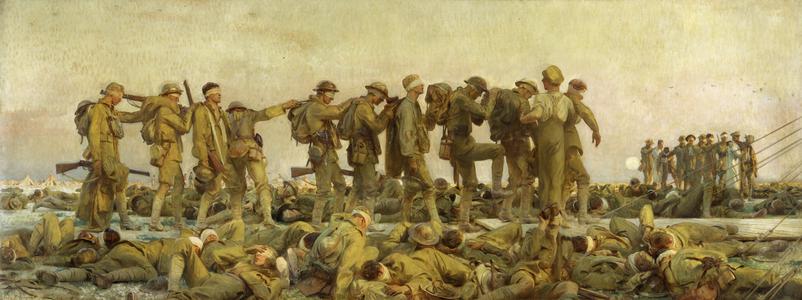
John Singer Sargent's "Gassed"

December 25, 2018

After having done most of his great portraits, bestowing a distinct life on each of the women who sat for him, Sargent seems to have been looking for something else to do. He travels the world and portrays it in a number of different styles. There are paintings of Italy that seem like finished architectural drawings, the lines clear, the colors muted; there are busy portraits of people sitting in their gardens, a multiplicity of pastel colors presented in somewhat broader brush strokes than Sargent had previously used. But there is one painting that stands out among these lesser Impressionist influenced paintings, and that is “Gassed”, an elegiac tribute to those wounded by gas in World War I. This painting might seem a mere magazine illustration because the drawing of the figures is not exact and because it seems to convey more information than it does artistically inspired emotion, but that would be to underestimate it, as the Imperial War Museum in London apparently does not, exhibiting the painting under glass as a solemn reminder of the Great War. Sargent used his formidable artistic skills to create an iconic representation of that war.

Now it would seem that to create something distinctive about that war would not be that difficult and certainly film has done that. There is the war in the trenches and the portrayal of that reaches back to at least the Twenties, so much so that it is jarring to see the major battle in “The Big Parade”, the great silent movie about World War I, having American troops proceed down a hill through a wood to engage the enemy. The image of trench warfare reaches to Kubrick’s “Paths of Glory” with its long tracking shot of Kirk Douglas walking through the trenches. Or there is the image of squadrons of biplanes that was started off in “Wings”, also from the silent era. But it is not just its subject matter, which are gassed soldiers, a sight that was never to be repeated in warfare until recently although expected to happen in World War II, that makes “Gassed” memorable. It is how Sargent painted it that gives the picture its emotional power.

The line of men in the center of the picture, the blinded and those temporarily blinded, all wearing bandages across their eyes, are leading one another by having an arm on the shoulder of the man in front, the men superintended by a medical orderly, constitute a frieze in that they are connected to one another but each one having his own story of injury to tell. One soldier’s arm is also bandaged; another lifts his leg too high as if there is an obstacle to walk over; another is turning off the footpath. These are the various agonies of war, as would befit their portrayal in a Greek raised relief. The line of the wounded also recalls the dance of the dead, which were the grotesques who marched in line, holding on to one another for support, while they were in the last stages of dying from the Black Plague.

Surprising, however, is Sargent’s use of light. The air is clear, not shrouded in the fog of battle, and so the men are clearly seen. The sun in the background, whether rising or falling, is an important part of the picture because the sallow light it sheds on the entire landscape makes the picture somehow supernal, an eerie light betokening some great catastrophe that has changed history, even though the whole point of the picture is to report realistically on what men in this particular distress, trying to recover themselves from their gassing, look like and how they act. Even the title of the paintings reveals that it is reportage. While most Sargent paintings are given the name of their subjects or the places depicted, here the title is a reference to an action so horrible as to outreach or transform the light shed on the world.

The color palette Sargent uses in this picture is limited. The men are portrayed in the same greenish yellow that also describes the terrain through which they walk. They look somewhat bronzed, as if the were already statues of their dead selves. They also move down a narrow path between lines of dead bodies perhaps to meet up to the right of the picture with a similar line of men proceeding down a different path on the way to the same local aid station. The soldiers are dressed in drab and rumpled uniforms rather than in shiny ones festooned with ribbons; they are not warriors going off to a glorious death but are victims who face a grim, slow and painful death even if some survive. So the picture is very painterly rather than photographic in that the alternative line of gassed soldiers seems there to balance the picture and give it directionality, the minimal of a story, while photographs would be more interested in the textures of the uniforms and the surroundings. This limited use of color reminds the viewer of another iconic painting of war. Picasso’s “Guernica” deliberately abandons Picasso’s use of very many colors in his portraits of the same time so as to get the granularity of a photograph, though I must admit I have never been much of a fan of that painting because it seems too much of an imposition of Picasso’s own vocabulary, the screaming bull, onto a subject so repellent in its own right and deserving the respect of more adequate representation.

Indeed, after Sargent, photography and film take over the field of visualizing warfare. The most iconic image of the Second World War is Jack Rosenthal’s photo of raising the American flag on Mt. Suribachi. That image was restaged for the photographer so that he could get the figures to stand as he wanted them so that one soldier is partly kneeling and the others are successively more upright. It could have been a pose for a statue, and a statue is what it in fact became the model for. The other image of World War II that has become iconic is the emaciated inmates of concentration camps staring out through the barbed wire, that recorded by both British and American cameramen. That image is so deeply ingrained in the modern psyche that as soon as the photos of emaciated inmates at Bosnian Serb prison camps in Bosnia were released in 1995, everyone around the world knew immediately that concentration camps had returned to Europe only fifty years after they had been eliminated forever.

So Sargent is at the end of a tradition that reaches back to Goya’s “The Ravages of War”, wherein painting does not represent military encounters or generals either triumphant or dying, but rather what happens to ordinary people, their pain, their mutilated bodies, their anguish, as a result of warfare. That tradition does not stretch farther back to Poussin’s “The Rape of the Sabine Women”, which also seems to portray a monumental historic event. Those women may resist their fate and are subdued by the Roman men, but they are not displayed as if in pain. Their fates are necessary rather than evil, that it will soon be over, the women given over to their new lives. The babies on the ground are crying but not hurt. There are no dead people, as there are in other Poussin paintings. The point about being gassed is that it is not quickly over for its victims and that it has a lasting impact on the world. And Sargent seems to know the monumentality of what he depicts, there being not much else he has to say about warfare, this being the only war painting of his that we have.


In ART CRITICISM Tags John Singer Sargent; "Gassed"; war imagery; war photography; war art
← 7/9: Morals in "Mansfield Park"6/9: The Tragedy of Incest →

Latest Posts

Featured
FILM
Black and White Morals
FILM
Read more →
FILM
POLITICS, EVERYDAY LIFE
Ambiguities in Languague
POLITICS, EVERYDAY LIFE
Read more →
POLITICS, EVERYDAY LIFE
POLITICS, PRIMERS
A Short Primer in Socialism
POLITICS, PRIMERS
Read more →
POLITICS, PRIMERS
POLITICS
A Short Post on Trump
POLITICS
Read more →
POLITICS
LITERATURE
Generic Reading Practices
LITERATURE
Read more →
LITERATURE
JANE AUSTEN
Janeites
JANE AUSTEN
Read more →
JANE AUSTEN
LITERATURE, WAR
Propaganda in World War II
LITERATURE, WAR
Read more →
LITERATURE, WAR
POLITICS, SOCIAL STRUCTURE
The Assassination Attempt
POLITICS, SOCIAL STRUCTURE
Read more →
POLITICS, SOCIAL STRUCTURE
POLITICS, WAR
Spheres of Influence
POLITICS, WAR
Read more →
POLITICS, WAR
PHILOSOPHY, POLITICS
Metaphysics at the Supreme Court
PHILOSOPHY, POLITICS
Read more →
PHILOSOPHY, POLITICS
LITERATURE, RELIGION
Dante's Immorality
LITERATURE, RELIGION
Read more →
LITERATURE, RELIGION
POLITICS
Constitutionalism Two
POLITICS
Read more →
POLITICS
SOCIAL STRUCTURE
A Social Scorecard
SOCIAL STRUCTURE
Read more →
SOCIAL STRUCTURE
PHILOSOPHY, RELIGION
Genres of Social Theory
PHILOSOPHY, RELIGION
Read more →
PHILOSOPHY, RELIGION
POLITICS, WAR
Experiments in Regime Change
POLITICS, WAR
Read more →
POLITICS, WAR
POLITICS
A Short Post on Organizing
POLITICS
Read more →
POLITICS
POLITICS, WAR
A Third Short Post on Iran
POLITICS, WAR
Read more →
POLITICS, WAR
WAR, POLITICS
Another Short Post on Iran
WAR, POLITICS
Read more →
WAR, POLITICS
POLITICS, WAR
A Short Post on Iran
POLITICS, WAR
Read more →
POLITICS, WAR
RELIGION, LITERATURE
Creation Fables
RELIGION, LITERATURE

The stories earliest listed in “Genesis” are fables rather than myths and so disclose a higher level of consciousness than to be found with myths.

The creation story in “Genesis” is a far more modern thing than it is usually credited with being  It is a kind of philosophical presentation and so very different from mythology which, as Ovid, that great student of mythology, noted, there are always biological transformations of things even while the gods remain subject to the forces of nature and the raging of human passions. Narcissus may become his image only symbolically, and not all narcissists become their images, but these are still myths because of the element of biological transformation.. The stories that follow the creation story are best explained, on the other hand, as fables, which are stories that explain a set of circumstances that do not seem to be created but which somehow were at a point in time and have become part of nature. Tigers have stripes and the Red Man got baked right, neither too dark or too light.. Fables suggest that there is a history for what seems natural, a sometimes serious, sometimes fey attempt to make explicable what seems not to need explanation or else to make explicable something which seems paradoxical: how something could come into existence when it already had to be there. Good examples of fables that follow soon after the creation story are the tower of Babeel, which is an exaggeration of what people can build and what happens to them, which is to have multilingual peoples, or Noah’s ark, which is an exaggeration of a boat that could be built rather than transforming animals so they could swim.

Read more →
RELIGION, LITERATURE
FILM, LITERATURE
"The Night Manager"
FILM, LITERATURE

John Le Carre is a serious novelist.

The secret of spy novels and movies is that they describe ordinary people doing universal things, however exotic is the setting and the premises are and that the people act outside the law. People can’t escape from or suspend their human nature evgen if they think they are beyond the restraints of the law. A good or even exemplary item of that is available in Conrad’s “The Secret Agent” where an anarchist wanders around London with bombs wrapped around him under his coat feeling comforted that at any moment he could explode himself. That seems bizarre or crazy until the reader recognizes that this is a kind of freedom. The anarchist has freedom to destroy himself which is an ultimate freedom because his control over it is absolute and without the constraint of others, purely subject to personal will. All people want to some extent to do what they want, to say fuck you to the world however ugly it may be and that gets externalized in the image of that anarchist.

Read more →
FILM, LITERATURE
POLITICS
A Short Post on Epstein
POLITICS
Read more →
POLITICS
CoverStory-TOMINE_PostVacation.jpg.webp
ART CRITICISM
New Yorker Covers
ART CRITICISM
Read more →
ART CRITICISM
updike.jpg
RELIGION, LITERATURE
Updike's "Toward the End of Time"
RELIGION, LITERATURE

The first of a two part post on John Updike’s “Toward the End of Time” through the analysis of generic types.                                                                                                    

Persistently undervalued, except perhaps for his Rabbit novels, because he is regarded as covering up facile meaning with an engaging writing style, the quintessential New Yorker writer, John Updike deserves more appreciation, even in one of his lesser novels : Toward the End of Time”. But in order to appreciate the novel’s achievement, step back a few steps and consider the kind of book it is, which is what I call a deficient epic. Updike is very careful about what each of her novels are, whether the saga of “In the beauty of the lilies” or the polemical politics of “Terrorist” or “Couples” as the romantic serio-comedy.

Read more →
RELIGION, LITERATURE
RELIGION
Noah the Technologist
RELIGION
Read more →
RELIGION
POLITICS, SOCIAL STRUCTURE
The Battle of Minneapolis
POLITICS, SOCIAL STRUCTURE
Read more →
POLITICS, SOCIAL STRUCTURE
Audrey old and youn.jpg
ART CRITICISM, PHILOSOPHY
Celebrity Images of Old Age
ART CRITICISM, PHILOSOPHY
Read more →
ART CRITICISM, PHILOSOPHY
POLITICS, PHILOSOPHY
Three Kinds of Government
POLITICS, PHILOSOPHY

Why there are only three kinds of government--monarchy, legislative authority, and mob rule--is a good question.

There are only three kinds of government. All the other types are variations of the three however spectacular some of them may be. The three types can be found in Aristotle’s “Politics”. There are governments controlled by the upper classes, and those can be dictatorial. There are those run by the middle class, and those are sensible and responsible. There are those controlled by the lower classes and that results in mob rule. The modern formulation was identified in the seventeenth century by Spinoza who identified there to be monarchies, which rested in agriculture, governments led by legislatures, which are based on commerce, and charismatic governments led by mob rule.. Consider the basic types and their variations.

Read more →
POLITICS, PHILOSOPHY
RELIGION, LITERATURE
Adam and Eve
RELIGION, LITERATURE

The story of Adam andEve work as fables, while the storyu of Samson and Delilah work as romance.

The creation of a woman should not be seen as an afterthought by a God who had previously provided each of his animals with a mate but overlooked doing it for Adam. God may have thought that Adam was a special enough creation, meant to rule over the rest of it, and so he did not need a mate. But either God changed his mind about that or always knew that he would make a special creation later. Woman was a special creation so as to emphasize that in the actual world the relation between man and woman is not like it is with the pairings of the other animals; some special kind of creation was required. Eve was as close to Adam as his own rib. As a legend might, the story of Eve’s creation suggests that woman has thereafter an ambiguous relation to man: part of him, descended from him, and yet a companion to him, and so clearly something different from what happens with some other created species no matter how much it might occur to a son of Adam or a daughter of Eve that the two sexes had different natures. We can see this more clearly if we consider the type of literary undertaking the story of the Garden of Eden is.

Read more →
RELIGION, LITERATURE
RELIGION
Genealogy and "Genesis"
RELIGION

Longevity is a weighty matter in “Genesis” and beyond.

The geneologies listed in “Genesis” are usually treated as filler so as to show the passage of time, allowing the reader to get to the next juicy story. but the geneologies have literary weight in themselves even though most of the names listed in the “Genesis” genealogies do not have stories associated with them. These people are described only by their lineage and their longevity. The genealogies would seem to say that in those distant times men were indeed titans. How are they titans? “Genesis” says it is not a matter of size or of wisdom or of language or of power but a matter of age. Descent simply ties together people noteworthy for how long they lived.

Read more →
RELIGION

Stories & Analysis of the Intersection of Culture & Social Structure

© 2016 -2024 Martin Wenglinsky